Interest Rates – What, How, and Why

Interest rates. You hear about it on the news, your co-workers are talking about it, but what does it really matter? “The Fed”, short for “Federal Reserve Board”, is the central banking system of the U.S.  They are the ones that control interest rates. It’s run by a board of seven people, called governors. The head honcho, currently Jerome Powell, is their spokesperson and leader. These people are appointment by the president, confirmed by the senate, and serve 14-year terms.  More powerful than President Trump, Jerome has the ability to alter the economy drastically with one sentence. The Fed is a powerful beast, unchecked by other branches of government and in charge of how much money banks must have on-hand (reserve requirement) and interest rates.

If Interest Rates Go Up:

It costs more to borrow money. If you’re thinking about taking out a mortgage or car loan, this isn’t good news for you!

It encourages people to save. You’re more likely to put your money in an account that brings you a 5% return than a 3% return.

Why raise interest rates? The Fed wants to curb inflation and encourage sustainable employment. If it were free to borrow money, spending would be out of control and the cost of goods would go through the roof.  Want to see what unregulated inflation looks like? Many third-world countries without a central bank experience massive inflation, as short-term success is prioritized over long-term stability. This is why $1 US Dollar is worth 70,000 Venezuelan Bolivars.

If Interest Rates Go Down:

It’s not that complicated, it’s just the opposite of what you just read.  The Fed will lower interest rates if they want to stimulate the economy. This is why rates dipped so low in the post 2008 recession climate. In late 2012 they hovered at 3.35% for quite a while. Rates have been steadily creeping up over the past couple of years, but are still relatively low compared to historical benchmarks.  Today, a 30-year fixed rate loan has a rate of 4.58%. In 1995, the same loan had a rate of over 9%, and in the 1980’s rates were in the 10-18% range. That makes for an expensive loan, but also leads to some nice interest payments if you have money in a bank account or CD.  You can see why it would encourage less spending and more saving.


You can’t control interest rates, but as you borrow or invest money they will certainly impact you.  If you hold bonds, you want interest rates to go down. This makes the interest rate on your bond more valuable in the marketplace. If you’re looking to make a large purchase that will require a loan, it’s a good time to do that when interest rates are low.  This is why people refinance their home mortgage. This is done at a point where the cost of refinancing (fees, etc.) is less than the money they will save with their new loan.  In summary, don’t stress over interest rates, but its probably a good idea to pay attention to them, or at least know what they mean for you.

Have a great week,

David

401(k) Plans – A Brief Rundown

In a world of odd acronyms, learning about retirement savings accounts can be overwhelming, and well, boring. 401k, IRA, Roth IRA, 403(b)…… the list goes on. At the end of the day, there’s an endless amount of knowledge you can attain and research you can do. Gone are the days of pension funds (unless you’re a fireman or police officer, essentially), where employees really didn’t have to worry about this sort of thing- their employer stashed funds away for them in exchange for a promise to send them a nice check each month in retirement. (That’s where your grandpa gets his gambling money from). If you worked long enough for a company with a pension, you essentially guaranteed yourself of sustaining your standard of living in retirement.  These days are over.  Our generation must take responsibility for our own retirement well-being, which can be scary.  However, this added control of your assets can also be extremely rewarding and lucrative. Set yourself up for country club tee-times, a nice cadillac, and mai-tais on the beach by getting informed now about something you’re going to really, really care about one day- your 401(k).  Wait too long, and you could be clipping coupons and just hoping to play the municipal course a couple times per year.

401(k) or 403(b) – these are essentially the same thing, it’s just that if you work for a hospital, school, or other similar non-profit organization it’s called a 403(b). The rest of the world deals primarily with 401ks. They are “employer-sponsored,” which for you just means they are operated via your employer. If your employer doesn’t offer a 401(k) or 403(b), you don’t get one. This is one way they are different than an IRA (Individual Retirement Plan), which can be opened by almost anyone that has a job and have nothing to do with your employer.

Pros:

  1. The part of your paycheck that goes into your 401(k) doesn’t get taxed, yet. This means it gets to grow and compound without a tax impact (until you are old and grey).
  2. You can make money in your sleep. Compounding interest is a beautiful thing and rewards those that start early and have time on their side.
  3. Your contributions don’t count towards your taxable income. This helps lower your taxes and offset some of the cash-flow “downside” to saving money.
  4. If your employer has a “matching” feature, they will match a certain percentage of your contributions. More on that to come.

Cons:

  1. In 2018, the limit you can contribute is $18,000
  2. Less cash flow on-hand, since you are saving.
  3. You can’t pull the money out before you are retired (or you switch employers) without a penalty. As long as you are an employee at the company, the money stays in the plan.  (there are a few things, like medical emergency or hardships, that allow you access to the funds penalty-free)
  4. When you withdraw the money (when you are old and grey) it will finally get taxed


Common Questions:

How much should I contribute?

  • If your employee has a “matching” feature, always contribute enough to receive the entire match. It’s free money, don’t pass it up! (example: if your employer matches 4% of your first 5%, always contribute at least 5%!)
  • Beyond that, 10% has traditionally been the rule of thumb. After you do a monthly budget, you should arrive at a number that you’re comfortable putting away.

How Is the Money Invested?

  • Your employer will often give you a few different options for how the money is invested (how aggressive it is in terms of stocks vs. bonds). The younger you are, the more aggressive you should be. To be more aggressive, allocate more to equities (stocks). 80/20 or 90/10 equity to fixed income ratio is appropriate for most in their 20’s and 30’s.

When do I get the money?

  • When you leave your employer or retire, you can withdraw the funds. You have a few options- you can roll the funds over to your new employer’s 401(k) plan, you can roll the funds into an IRA (article coming soon on these), or you could receive a check. There are some tax consequences depending on the option you choose, but just know the money is yours!


It can be scary to voluntarily give up control of thousands of dollars each year. Your employer should keep you updated on how the account is performing (will depend largely on the stock market and economy) and you can watch your nest egg grow and grow. The most important thing is to get started early. Compounding interest is a beautiful thing, and getting started in your 20’s with a moderate savings each month can vastly outperform someone in their 40’s trying to play catch-up.

There are a ton of different variations on 401(k)s and different features that employers can offer. Don’t be embarrassed if you don’t understand the fine print- ask questions.  Your employer is required to provide materials that explain the 401(k) plan and all that you’re signing up for. Chances are, most of your co-workers don’t know the ins-and-outs of the plan, either.


Have a great week,

David

Car Insurance: Boring but Important

Your windows are down, the sun is shining, and you’re reading the most recent MoneyStuff article as you drive home.

Wham!

Getting into a fender is about as fun as going to the DMV. Especially if its your fault. But that’s why you’ve got that insurance, right? Well, if you’re like a lot of us that don’t hit people often, you probably don’t know what’s actually in that insurance policy you blindly pay for each month. Don’t wait to reference your policy until its too late. You’ve worked hard for your money- you want to protect it.

An insurance policy can be confusing. Here are two extremely important coverages you want to be familiar with:

  1. Property Damage Liability
  2. Bodily Injury Liability

Property Damage Liability. In Washington State, the minimum property damage liability coverage required to be on the road is $10k. Sounds like a lot, right? Well, not really, considering this is supposed to pay for any damage to another car, fence, lemonade stand, etc. that you may have caused. One fender bender to a Tesla will likely be $20k+.  Guess what happens to that extra $10k that isn’t covered? You could be liable for it out of pocket.  The good news is, it only costs $2 or $3 per month to raise your coverage from $10k to $100k. Especially if you drive a larger vehicle, you could easily cause more than $10k worth of damage to one or multiple cars in an accident. Give yourself peace of mind and make sure you have at least $50k or $100k (the increments are 10/25/50/100/300k) in property damage liability coverage. If you aren’t sure (like me at the time of my fender bender) go look at your policy online or call your insurance company.

While you’re at it, look at your Bodily Injury Liability coverage. It will read as something like $100,000/$300,000.  This format means “per person”/”per accident”.  So from that fender bender with the Tesla, you are covered for up to 100k of their medical bills. If they have passengers in the car, you are covered for up to 100k of their medical bills too. Phew, good news. But, it only goes up to $300k total. So if you accidentally hit a passenger bus and 8 people suffered broken arms, just hope that their bills collectively stay under $300k.  There are lots of options for how much bodily injury liability coverage to have. If you’re an awful driver with a Hummer and are worth millions, I’d say pay the extra couple bucks and spring for something like $300k/$500k or $500k/$1mil.  You don’t need some guy in a neck brace coming after your hard-earned assets in court.

So, while we are all confident in our driving ability, accidents do happen. For the price of one Egg McMuffin per month, you can protect yourself exponentially more than your current level.  People don’t usually choose the type of car they hit, so you never know what you could be on the hook for. It’s like a box of chocolates or something.

Your insurance company isn’t going to try and sell you a better level of insurance for only a couple bucks more each month, as it isn’t advantageous to them. So reach out to them  and make sure you’re comfortable with how much coverage you have. Oh, and try not to hit anyone.

-David

← Back

Thank you for your response. ✨

Warning

Warning.

Back to MoneyStuff Home

Getting Buckets

Arguably more important than getting buckets at your local YMCA, getting financial buckets in an excel get bucketsspreadsheet can bring you serious peace of mind.  “How much should I invest? What should I keep in savings? When should I invest in the stock market?” Often, the most common questions are the most important questions. Here are some basic, fundamental bucketing rules that will set you up for success:
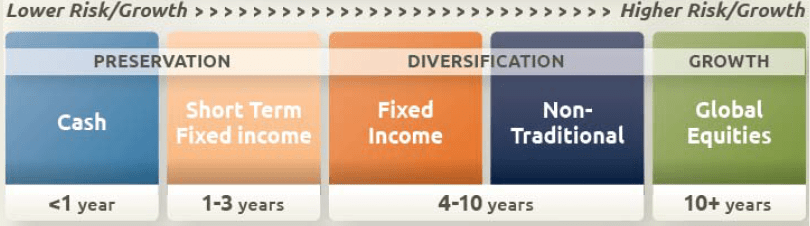
Bucket 1: Cash  *Priority #1

  • A good rule of thumb is to keep 3-6 months of basic living expenses (rent/mortgage, food, transportation, etc.) in “cash.”
  • “Cash” doesn’t mean wads of twenties in your sock drawer, but rather just money in a place that you can access at any time without penalty. So whether that’s in a checking account, a high-yield savings account (available at most major banks), or actual cash, having this buffer will set yourself up for success.
  • The unexpected can happen- good or bad- and now you will be prepared for it. Having cash on hand will bring you peace of mind.  Lose your job? You have months to find a new one. Need to pay the premium due to a fender bender? Use these funds rather than pulling from your investments in your other buckets or taking out a loan. Want to buy those Final Four tickets? You won’t need to dip into your investments.  You get the point.
  • If you are forced to use this cash, your goal should be to replenish it back to its original balance.
  • Sitting down and calculating what you could really be living on each month can be a great exercise and help you become more conscious of your spending habits. Be warned though, you may see your next monthly credit card bill and wonder, “how the hell did that happen?”


buckets

Buckets 2-4: Investments

  • We will go into these specifically in the future. Just remember that the sooner the need the money, the more conservative you should be. If you know you won’t touch the funds it for 10 years (retirement), you can be really aggressive right now. Why 10-years? In the history of the stock market, the market as a whole has provided positive returns in 95% of all 10-year time periods. Yes, even when the Great Recession of 2008 is included. If you can guarantee that you won’t touch this bucket of money for the next decade, it’s a pretty sure bet you will have at least as much money as when you started. And that’s a good feeling.  Instead of buying individual stocks, you are likely better off by getting ETFs (exchange traded funds) such as SPDR or VOO. If stocks are individual players, index funds are like teams. SPDR and VOO are teams comprised of the 500 biggest public companies (Apple, Google, Amazon).  If the stock market is doing well, these teams are doing well.  Even if a couple individual players are having a bad season, the team still succeeds. The trick is, not pulling your money out when the team goes on a losing streak. None of us have time to research and trade individual stocks and try to consistently beat the market.
  • Since 1928, the stock market has an average annual return of 10%. In 2017, that return was 19%. In other years, it may be negative. If you are going to invest in SPDR or VOO, you need to be able to withstand these peaks and valleys in order to experience growth.

3 Key Takeaways

#1: Have a bucket of funds you can access immediately, should anything come up.

#2: Invest with goals and a timeline in mind.

Short Term, play it safe.

Long term, can afford more fluctuation in value.

#3: Individual stocks are overrated and won’t win consistently. For every one stock that does well for you, another will tank. Professional stock traders have a goal of beating the index (S&P 500) by maybe 1 or 2%. As an individual investor, just get an index fund and let it ride. (SPDR or VOO are great to start with).