Good News – 2020 Isn’t Over (Hold on… why is that good?)

It was no secret, people were anxious to welcome in 2021. The new year brought with it hope and a much needed turn-the-page moment to most everyone on the planet. Seeing friends and family, sporting events, in-person learning. The prospects for 2021 were glorious. Good riddance, 2020. But hold on one second… 2020 isn’t over when it comes to one very important thing: IRA contributions!

That’s right, you procrastinators out there still have until April 15th, 2021 to make your 2020 contributions to your individual retirement account (IRA) or Roth IRA. The maximum you can contribute for 2020 is $6k if you’re under 50, and $7k if you’re 50 or over.

Why Contribute?

  1. Use it or lose it. You only have from January 1, 2020 until April 15, 2021 to make your 2020 contributions. You can’t go back later in life and make up for prior years. With such a small limit of $6k, the key to long-term success is starting early and remaining consistent.
  2. Tax-free growth (Roth IRA) or at least tax-deferred growth (Traditional IRA). If you’re thinking, “tax free sounds better than tax deferred,” you would be right. If an IRA is that new car you’ve been looking at, a Roth IRA is the “Sport” version with the leather seats.
    • With an IRA, you (or your heirs) will eventually be taxed on any dollars in the account that haven’t been taxed before. But, in the interim, you get the benefit of compounding returns as you don’t have to pay any capital gains taxes on the earnings as you go. If you contribute to your IRA from your checking account each year, those are after-tax dollars and won’t be taxed again. If you rollover your previous employer’s 401k, those are pre-tax dollars and will one day be taxed, in addition to the earnings in the account.
    • In a Roth IRA, you contribute after-tax dollars and all growth within the account is tax-free as well. So even when you’re 80 and want to buy that bucket-list ticket to Mars, you can use your Roth IRA and won’t be taxed. Every penny in the account is yours, as long as you don’t withdraw earnings in the account before 59.5 (with some exceptions). Regardless of when you withdraw from your Roth account, every dollar you contribute is always yours, no penalties or taxes, ever. That’s because all contributions to a Roth IRA are made after-tax. Here’s a great Schwab summary for more info.

Depending on your modified adjust gross income, you may be ineligible to contribute directly to a Roth IRA. Before I provide the link to the chart of eligibility (ok, I just provided it), if you find yourself ineligible to make a full Roth contribution, you can always utilize what’s called a backdoor Roth conversion. It sounds more devious than it really is. You won’t end up on the latest Netflix documentary detailing white collar crimes for utilizing this strategy. The Roth IRA is probably younger than you, actually, as it wasn’t created until 1998. Point being, the kinks are still being worked out, and you’re not wrong for thinking, “these rules make no sense.” For a while, there was a debate regarding if backdoor roth conversions were a legal loophole in the system. The debate is over, they are legal. To make a backdoor conversion, you contribute first to a traditional IRA (ideally with a zero balance) and then move the money (convert) to your Roth IRA. If you had only after-tax money in your IRA, the conversion is a tax-free event. If there is any pre-tax money in your IRA, that complicates the picture a bit and will trigger some amount of tax.

You Made the Contribution… Now what?

Investing within your IRA or Roth IRA: With these accounts being pegged for retirement, they probably have a pretty long time horizon for you compared to your other investment account(s). With a long time horizon and tax-deferred or tax-free growth, investors often find it makes sense to hold their more “growthy” assets in these accounts. As an example, if an investors entire portfolio is weighted to 70% stocks and 30% bonds, their Roth IRA may be weighted to 85% stocks and 15% bonds, while their individual (taxable) account may be closer to 60% stocks and 40% bonds. It would depend on the amounts in each account to arrive at a total weighted average of 70% stocks. As investors get older and closer to possibly using their Roth assets, they tend to scale back on the risk and reward, instead finding more value in stability.

If you have extra cash on hand and are looking to build your retirement nest egg, take advantage of your IRA or Roth IRA contributions each year. Your wall calendar may say it is 2021, but there’s still time left to make 2020 better!

What’s the Alternative?

When your mom said you had to eat the carrots on your plate or swap them for broccoli, there was never an option of, “you know what, Mom? I’m not going to eat a vegetable tonight” (If only it were that easy). Instead, you had to buck-up and evaluate your options. In this case, the lesser of two evils.  Yet, so often, choices are presented without regard for the realistic alternative. The important question is not, “do I want to eat carrots or not?” Rather, it is, “do I want to eat carrots or broccoli?”

When you are prepared, the best option is usually sticking with the status quo. If there are carrots on your plate and you know you have to eat a vegetable, maybe stick with those instead of panicking and opting for the broccoli. But, there is one factor that inherently makes people ditch the status quo and unwisely opt for something else. That is the fear factor. No, not the show hosted by Joe Rogan where contestants would sit in bins of snakes or eat Rocky Mountain Oysters. Rather, we’re talking about the natural instinct we have to take action when we expect adversity is on the horizon. If poorly prepared, this makes sense and is a great benefit to our survival. Get out of the hurricane’s path. Swerve to miss the deer in the road. You get the idea. However, sometimes we can let fear drive us to make unwise decisions. We swerve too far, missing the deer but driving the car off the bridge. Or, we decide to not drive at all for a few months. We avoid the immediate risk, but bring about a whole host of other problems.

Imagine if before the NBA Finals, both teams began trading away all of their players for new ones. After all, they are about to play an incredibly good team, and the series is going to be tough! There will be adversity. Heck, probably even lose at least a game or two. But these teams would be forgetting that they already have great players, which is what got them to this point in the first place. Worse yet, one team decides to forfeit to avoid the potential agony of losing the series. Investors often treat their portfolios the same way. When they see a rough patch on the horizon, they automatically look for something else. Often times, this is cash or a money market. Less risky, less volatile. Completely avoid the rough patch at all costs. In a vacuum, this strategy is sound. But as we know, the world is anything but a vacuum. Avoiding a potential short-term rough patch often directly leads to a long-term nightmare.

Just ask Kevin Cash, manager of the Tampa Bay Rays. In the sixth inning of Game 6 of the World Series, Cash pulled starting pitcher Blake Snell from the game, despite absolutely dominating the Dodgers and only having a pitch count in the 70’s. Cash’s rationale for the move is that he didn’t want Snell to face the top three hitters of the Dodgers lineup again (who was a combined 0-6 with 6ks against Snell). If there were an option to simply not have anyone pitch to these hitters again, Cash’s logic is sound. But SOMEBODY for the Rays was going to need to throw the ball over the plate to these hitters. Cash was in a position of power, he just didn’t realize it. He could stick with his current dominant pitcher, or roll the dice with someone else out of the bullpen. Being in a position of power allows one to not make a change. The best option is the current option. In this case, Cash’s options were 1. go to a reliever , or 2. stick with the starter, Snell. On that night, Blake Snell was the best pitcher on planet earth. But, operating out of fear led Cash to make a panic move. He felt he had to do something to help his team, when in fact the best option (especially in hindsight) was to take no action at all. When we get nervous of what lies ahead, humans often cope by taking action. It makes us feel better, more in control. We are preventing disaster! Kevin Cash’s reason of not wanting Blake Snell to face those dangerous Dodgers hitters again is hard to argue with. As it turns out, those hitters definitely didn’t want to face him again, either! Remember, 0-6 with 6ks combined. But I digress… For Cash to weigh Snell facing those hitters versus Snell not facing them was not an accurate comparison of his choices. Rather, it would be Snell facing those hitters again, or a reliever entering the game to face them. THAT was the decision. It was going to be a daunting task for whoever was on the mound for the Rays.

It’s convenient that the Rays manager is named Cash, because this story directly relates to investing decisions that millions make every day. As the market hits all-time highs, the whisperings of impending doom start to trickle in to the mind’s of investors. Stick with their current investments they hold, or is it time to get into cash?

 Markets crash to varying degrees, we know this. After all, withstanding volatility is the price of investing in equity markets. Those that wish to invest but not pay this fee usually attempt to do so by “timing the market”. However, this often results in an investor doing what Kevin Cash did. They sell too early, and are stuck sitting in cash as the market continues to experience positive returns. They let fear drive decisions, blinding them to the fact that maintaining their current strategy is potentially the best option. After all, it’s our instinct to respond to fear with action… Do something! Just make it better! Outmaneuver and outsmart the competition. So what does this often look like?

Let’s say a nervous investor decides they are going to sell their stocks and move into cash, so they can proudly tell their friends of their wisdom as the market declines and they wait to buy-in at a lower point. This sounds great, just as great as no Tampa Bay Rays pitcher having to face the Dodgers best hitters.

We can call this moment in time the investor sells his stocks, “Point A”. After Point A, one of two things will happen: market returns will be negative, or they will not. If they are not, one of two things will happen:

  1. With serious FOMO (fear of missing out) the investor admits they were wrong, buys back-in to the market at similar or higher values than when they sold. They lost out on returns between Point A and this new point in time, Point B. Not only did they lose value by buying at higher prices, they’re also right back in the position they were trying to avoid, set-up to go through the next phase of market volatility that hasn’t yet struck.
  2. The investor stays stubborn and waits for a crash, which may or may not bring values below point A. Even if they do get below Point A, will the investor feel comfortable buying back-in during such volatility?

But what if the investor is right, you say? What if they do time it well and the market does crash right after they sell. Well, once again, one of two things will happen:

  1. Investor buys back in at a point lower than Point A.
  2. Investor keeps waiting, sure that the market has more room to fall. They don’t get back into the market until it is too late, and they likely don’t get back in until levels approach Point A. At best, it is a wash for this investor.

Not many people achieve result #1 of this scenario, as nobody wants to buy back-in too early and experience some of the market correction they set out to avoid. So, #2 is all too common. And keep in mind, that’s only IF the investor is right at Point A and times the market well. Of these 4 scenarios, only one (25%) potentially turns out in the investors favor, and it’s often the least likely to occur. So, it’s no wonder that a Fidelity study found that the best investors on their platform were “either dead or inactive.”

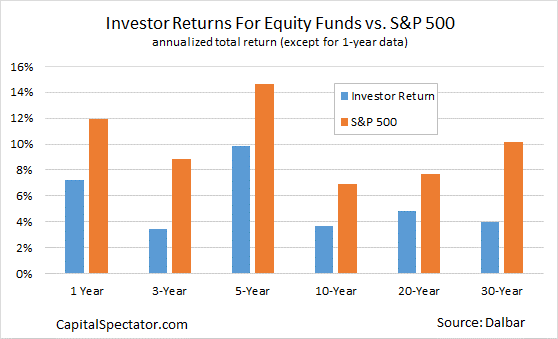
“Investors so often cost themselves money because the behaviors elicited by short-term focus are almost always irrational….While many investors set a course of action that is based on a well-planned rationale and considers the full time horizon, those plans can take a back seat when fear or exuberance sets in.” (Dalbar)

Eating vegetables, tough games, good hitters, and market volatility are all going to occur. The only way to avoid this is by not eating healthy food, not playing the game, and not making long-term investments. You can seek to avoid unnecessary risk, while acknowledging you’ll never eliminate all risk. If you have a solid long-term investment plan (or dominant starting pitcher), you can afford to operate from a position of power when evaluating risk. Perhaps fine-tune your allocation to make sure you’re properly diversified. It’s the equivalent of going over your scouting report with your team and putting in a few new plays, rather than undertaking a roster overhaul. After all, when you have prepared and are invested in appropriate assets (or starting pitching), sometimes the best move to make, is no move at all.

References

Dalbar Quantitative Analysis of Investor Behavior Study. https://www.dalbar.com/Portals/dalbar/Cache/News/PressReleases/QAIBPressRelease_2019.pdf

The “Welcome to Parenthood” Financial Checklist

Being a new parent can be an incredible, stressful, and incredibly stressful time all at once. So much to learn and do, from pediatrician appointments to perfecting your swaddling technique. But there are a few critical items that you can be doing now that have the potential to make a huge impact in your family’s future.

As a new parent, I’ve found that using to-do lists has been helpful for my sleep deprived, distracted brain. As a Certified Financial Planner, I know what items are especially important for clients with young kids. The list below is geared towards helping out parents that have just welcomed a newborn, whether it’s their first or their fifth. These things don’t make for great conversation at a party and certainly aren’t as Instagrammable as a cute photo of your little one. But perhaps that is the point. There are no constant reminders by your friends to get these things done. No social pressures, and often times no immediate reward. What they will bring you is peace of mind, more financial freedom, and a bright future for that new baby of yours.

1. Update Your Beneficiaries

Hopefully, you already have a primary beneficiary on your financial accounts (if not, let’s get that done too). For most, the primary beneficiary is their spouse. But what happens if you and your primary beneficiary both get hit by a meteor? That’s where your contingent beneficiary comes into play. If this is your first-born, you’ll likely want them as the contingent beneficiary. If this isn’t your first born, this is even more crucial. You don’t want to spark an argument because Johnny gets your Roth IRA and Sally gets nothing.

Making the changes is easy and can usually be done online in a couple of minutes. Remembering all of your accounts can be the tough part. Here’s a few suggestions to spark your memory:

  • Employer Retirement Accounts – (401k, 403b, etc.)
  • Individual Retirement Accounts (IRA, Roth IRA)
  • Brokerage Accounts
  • HSA Plan

2. Create/Update Estate Planning Documents

“Estate Plan” is a general term and can encompass wildly different things for different people, depending on what state you live in, your assets, and your personal preferences. However, there are 5 documents to make sure you have at a minimum. Estate plans can vary as widely as cars, but these are the tires and steering wheel:

  • A Will
  • Durable Power of Attorney – Healthcare
  • Durable Power of Attorney – Finances
  • Health-Care Directive
  • Burial Instructions

If you already have them, you should update them to include your new screaming bundle of joy. Don’t have them? Not to worry, there probably wasn’t a real need… until now!

Lost? Read here or contact an estate planning attorney. For a cost effective solution, consider utilizing a software like Quicken Willmaker 2020. This is essentially the TurboTax for estate documents.

3. Open A College Savings Account

Alas, something that doesn’t involve you dying! There are a ton of ways to save for college, but a couple of them have distinct tax and investment advantages; a 529 plan being one of them. They are easy to set-up, experience tax-free investment growth, and if your little one is lucky enough to have multiple people in their life that would like to contribute, it makes that easy as well. You can also transfer money between your kids, so if the oldest lands a scholarship or ends up not needing the funds, you can always use them for a sibling. Here’s a great article that answers more common questions about 529 plans. So how do you set one of these up? my529.org is a great place to start, unless you live in a state with state income tax benefits. You’ll also have the ability to select what type of investments you would like in the account. One common choice is to select a fund that is more aggressive early-on and tapers to become more conservative the closer the beneficiary (your kid) gets to being 18.

4. Update Your Health Insurance

If you and your spouse both work, chances are one of you has a more favorable health care plan to add the new kid onto. Factors to consider are monthly premium deducted from your paycheck, deductible, and out of pocket maximum. Talk with your Human Resources department to get a summary of the changes that would occur should you add the little one to your plan.

5. Budget for Near Term Expenses

Daycare? A new vehicle? More coffee? It’s likely you have some new expenses you had planned for, and others that maybe were a bit more unexpected. It’s a good time to revisit your monthly budget now that life has changed a bit.

Still Waiting for your CoronaVirus Relief Check?

Many have received their stimulus check via Direct Deposit IF the IRS already had their bank account info. Why would they have that? Only if a refund was received in one of the last two years. For those not in that boat, quite a few have received their check in the mail.

Are you still waiting on your check and worried it may not arrive? You have until May 13 to enter direct deposit instructions and also sign-up for updates on the status of your check. IRS Stimulus Check Status

There is a high likelihood of at least one additional round of payment coming, so getting your direct deposit info now will help expedite the receipt of that next payment as well. If you’re like me and occasionally have your mail stolen from the mailbox, I highly recommend getting yourself set-up for direct deposit!

Wondering if you’re eligible to receive a check at all? If your Adjusted Gross Income was less than $198k (married filing jointly) or $99k (single filer), you will receive something. The most you can receive is $1200 ($2400 for Married Couple). However, if your AGI is above $75k Single ($150k MFJ), you’ll receive only a percentage of the full amount. Confused? Just dig out your 2019 tax return and enter your details here: Check Calculator


The Tax Man is Coming…

Tax season is here… so how can you (legally) owe less to Uncle Sam?

4 Common Ways:

  1. Tax Deductions and Credits (good)
  2. Make Less Income (dumb)
  3. Make Less Taxable Income (smart)
  4. Get Married (could be any of the above)

Let’s go through each of your options… stay with me here. This will be the quick and painless version of a topic many consider to be dry. But you know what isn’t dry? Keeping more of your hard-earned money.

Deductions and Credits

Tax Deductions reduce your taxable income. For 2019, 99% of us will use what’s called the “Standard Deduction.” Unless you’re donating tens of thousands to charity this year, you’ll be taking the standard deduction of $12,200 in 2019. The Tax Cuts and Jobs act of 2017 doubled the standard deduction, which in effect helped everyone that didn’t have a huge mortgage or were making huge donations. If you’re filing as a married couple, you get a standard deduction for each of you, so $24,400 total.

Tax Credits reduce your tax owed dollar-for-dollar. They’re more impactful than deductions because instead of decreasing your income, they reduce the tax you owe (or increase what the government owes you).

Example: Mookie has taxable income of $100k and has an effective (average) tax rate of 20%. He receives a deduction of $10,000. This saves him $200 in taxes.  OR Mookie receives a tax credit of $10,000. This saves him $10,000.

So, how do you get tax credits? Well, there are a quite a few credits the government has come up with, many of them geared towards helping out low-income households and/or college students. The most common credit is the Child Tax Credit ($2k per kiddo).

rockaroo
Weird baby chairs will offset the child tax credit.

There are also credits for child-care costs up to $2k. Now, before you tell your spouse you’re ready for some $2k tax credits to be walking around your house, I can assure you that having a child for financial reasons is still not a savvy move. The government is taking pity on you for how much you’re probably spending on diapers, food, and those crazy chairs that move the baby around in some sort of figure eight pattern.

Make Less Income

Really? As they say in “the biz”, don’t let that tax-tail wag the dog. Instead of telling your boss, “Hey, I appreciate the raise but I don’t want to pay more in taxes,” let’s look for other ideas that won’t make you and your spouse hate me.

Make Less Taxable Income

Ok, so what’s the catch? How can you make just as much or more gross income but less taxable income? Save more into your employer’s retirement plan. These are “pre-tax” dollars, meaning they come out of your paycheck before it even gets to you. If you make $500k and had $15k go into your pre-tax 401(k) plan, now your income is only $485k (then subtract standard deduction, etc., to arrive at taxable income). The tax bracket system is progressive, meaning that the more you make, the higher your tax rate is on the next dollar you make. Not only is your total tax bill going to be higher, but the rate increases as you move up the brackets. We must distinguish two VERY important terms you’ll want to know.

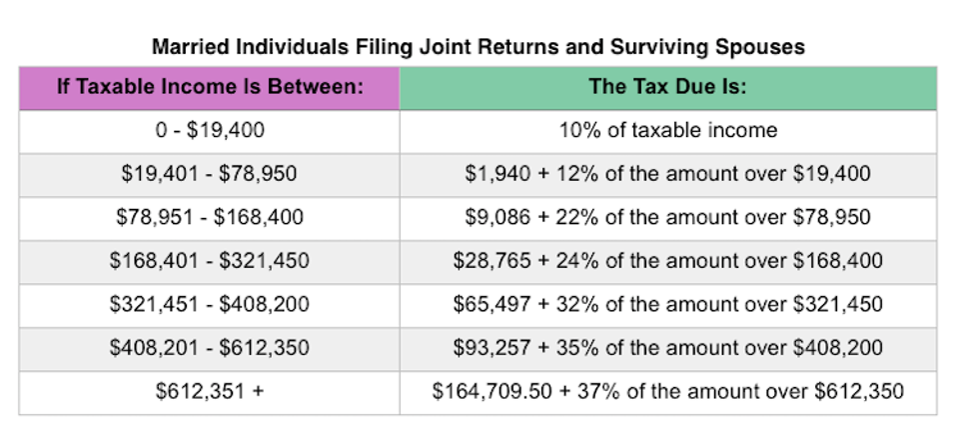
2019 tax brackets MFJ

Effective Rate: Tax due divided by taxable income. The average rate you pay.

Steve’s taxable income is $168,400. So, he owes $28,765 in taxes.

($9,086 + (22%*($168,400-$78,950)).

When we divide that by $168,400, that equals an effective rate of 17%.  This makes sense, as $19,400 of his income was taxed at 10%, the next $60k was taxed at 12% and the next $90k was taxed at 22%.

Marginal Rate: tax due on the next dollar made.

For Steve, if he made $1 more, what rate would it be taxed at? That’s right, 24%.  The marginal rate will always be greater than the effective rate, unless you make less than $19,400. Then, they would be the same.

Still with me? Good. Almost done, I promise.

So what’s the big deal with these brackets? How can they be used strategically? Well, you’ll notice some rather large jumps in the tax brackets. From 12% to 22%, and another big jump from 24% to 32%. Time for our last example:

  • Laura makes $90k. She doesn’t contribute any pre-tax dollars to her company 401k.  She owes $11,517. Her effective tax rate is 12.8%.
  • Cameron makes $90k. She contributes $15k in pre-tax dollars to her 401k plan, lowering her taxable income to $75k. She owes $8,612. Her effective tax rate is 11.4% of $75k. By avoiding the huge marginal spike from 12% to 22%, she saves thousands.

Now, any pre-tax contributions will be taxed at some point. The IRS doesn’t give up that easily. But, the bet is that in retirement you aren’t making much taxable income and your marginal rate is lower than it is today. In addition, you get the compounding growth of that pre-tax $15k over time, which is an immensely powerful thing. By smoothing your income over time, you can avoid dollars being taxed at high marginal rates. There are multiple other ways for people with volatile earnings patterns to be strategic about the amount of their income exposed to high tax brackets during their best years. Professional athletes, entrepreneurs, and entertainers all need to be strategic about ways to defer income. That is, recognize it later in life during years where they are in lower tax brackets. This could especially be huge for a single filer that will be married later in life. This takes us to our final point:


Get Married

There are VERY different tax tables for married couple than for single. But, similar to having kids, don’t let the tax advantage lead you down the aisle. Just know that if you’re filing as “single” you are paying the very highest rates. Deferring income until you’re married could be highly advantageous, especially if your spouse will be making less than you. Try to put as much away pre-tax while you’re filing single. Save money saving money!

That’s it for now. Congrats on getting through this article. Hopefully you feel smarter and are ready to be tax efficient. Let me know if you have any questions.

-David


PS. TurboTax suits the vast majority of people just fine, especially when younger and without a ton of complexity. Many enlist the help of a CPA, but unless you have a complicated/unique tax situation, it may not be worth the cost, which can be hundreds to thousands. Examples of when a CPA may be especially helpful are if you have multiple income streams, large amounts of investment income/losses on your form 1099s, investment properties, child support, owning a business, etc.

Real Estate Investments

Rent or buy? We’ll all likely face this decision at some point in our life. There are a ton of factors to consider, including interest rates, expected time period in the home, and your ability to finance it.

The advantage of home ownership is that you’ve secured your place on the roller-coaster ride of your local real estate market. If you plan on sticking in the area for some time, it’s comforting to get your seat on the ride. Whether the market goes up or down, you’ll always be able to sell and find another place in the area one day. The value of your property is going to be correlated to surrounding properties. If not, rents could rise in the area without your salary making a corresponding move, you could find yourself in a tough spot. Another scenario is that if you buy a home in City A but one day hope to move to City B, you’re at risk of City B property value appreciating at a higher rate than your own. As time passes, you may be saving towards one day affording that next home in City B, but in reality getting further and further from your goal.

The main advantage I see for homeowners is “forced savings” into an investment. Yes, your monthly mortgage and tax payment is greater than paying rent would be. But you’re paying for ownership of property, which is a great thing as long as the property is appreciating. Property has historically increased in value, or appreciated. However, areas do go through their own recessions and are subject to local legislative and economic risk.

If you’re currently renting, it takes a little more discipline. Figure out what it would cost each month to own the home you’re renting. Take the difference between that amount and what you pay in rent, and try to force yourself to set that aside each month. If you’re saving up for a down payment, leave in something stable, such as a money-market fund or short-term bonds. If you’re investing for the long-term, look at an index fund such as VO that will follow the S&P 500 closely. Because although it takes more cash to own and maintain a home than it does to rent, that homeowner is “in the game” and benefits from land value appreciation in the area.

Looking to own a second home and perhaps be a landlord? There are a ton of factors to consider that may make you second guess this. It can certainly be lucrative from an investment perspective if you find a market that is about to pop. However, taxes, closing costs, maintenance expenses, etc. all cut into your bottom line. It also may be prudent to diversify from a geographical perspective. If you already own a home in Denver, is it really wise to put all of your eggs in one basket and buy another home in Denver? It’s definitely a riskier play than having one home in Denver and another in Los Angeles. Contact me for a free spreadsheet that can help you work through what you can afford, financing options, and everything to consider when looking at purchasing a rental property. There are many successful real estate investors, but equally as many that go belly-up thanks to being unprepared for what they’re getting into.


Save Thousands on Your Taxes This Year

Looking for a way to save money and invest while paying less in taxes for 2019? Well, if you’re not maximizing your 401k contributions for the year, you can.

The most you can contribute to a 401k (or 403b) for 2019 is $19k. These contributions are taken from your paychecks, and usually come with some sort of matching contribution by your employer. The great thing about this savings is that it’s pre-tax. So, instead of making $100, paying $20 in tax, and investing $80, you get to just invest the $100. But that’s not the only advantage…

When it comes time to file your taxes in April of 2020, that $100 won’t count as income. For a married couple, this is potentially $38,000 less in income for the year. Let’s say that combined you make $150k. That means your marginal (highest) tax bracket is 22%. Reducing your taxable income to $112k reduces your taxes by $8360.  For full disclosure, you will eventually have to pay those taxes when you take the money out of your IRA, but you’ll be old and wealthy at that point anyway. Not to mention, you won’t be working (probably) so your tax bracket is likely to be lower. Even if it’s not, that $8360 was working FOR YOU instead of for the tax man, so it compounds again and again over a span of decades. It’s powerful stuff.

Not going to max out for 2019 at your current deferral rate? Contact your company’s HR department and request to increase your deferral percentage. Each year, run a calculation to see what percentage you need to defer to max out the 401k contribution. The limit is $19k for 2019, but it could increase for 2020. The IRS will let us know shortly what that limit will be.

Maybe the biggest advantage of increasing your 401k deferral is that it creates forced savings. We naturally adapt to things in our life, and I promise you you’ll adapt to this new percentage coming out of your paycheck. Forced savings is your best friend, especially into a tax-deferred account like your 401k.


Presidential Impact?

Two questions for you.

  • On a scale of 1 to 10: How much impact does the president have on the stock market?

Ok, did you come up with your answer?

  • On a scale of 1 to 10: How much impact does the president have on the value of companies relative to their current stock price?

Ok, I lied. It was just one question phrased in two ways. Did you have two different numbers in your head?

When you really think about what the stock market is and how it is valued, what role do politics and specifically the president play?

Unless you’ve been under a rock for the last few months, you’ve heard about President Trump’s twitter-battles with China (tariffs) and the Federal Reserve (interest rates). Each 140 character tweet seems to impact the market, and it has surely been a bumpy ride. When speculation of a trade deal with China increases, the market has responded well. Is it because investors know the terms of the deal and they’re especially favorable? No. It’s because a deal means certainty. Put another way, it removes uncertainty. However, when Trump then throws up his (tiny) hands in frustration and the two countries go back to the drawing board, the market takes a dip. Up, down, up, down, it seems.

The stock market is a mysterious beast. If there’s one thing we know, is that market volatility is tied to ambiguity. It likes predictable results. So with the 2020 election approaching, what does that mean as an investor? Will markets do better with Republican in the White House or a Democrat?

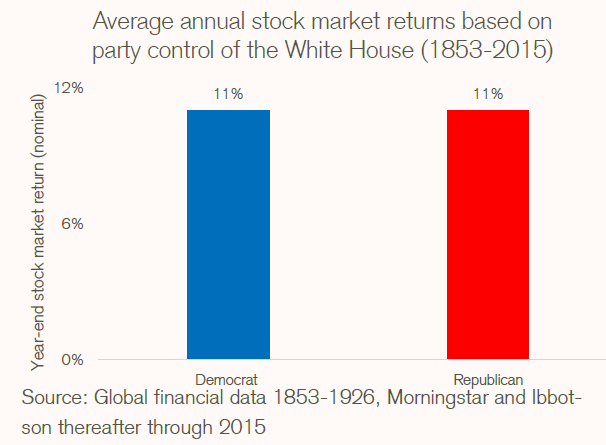
Well, historically speaking, it doesn’t really matter:

Capture


This lends itself to a larger point. The stock market is made up of publicly traded companies. A stock price goes up or down based on what investors believe/calculate it to be worth. Micro-economic factors are those specific to a company. Did the CEO quit? Is the product catching on fire? Did they make a breakthrough? However, if entire industries increase or decrease in price, it is due to a macro-economic factor:

Macro-economic factors:

  • Economics
    • interest rates
    • inflation
    • employment
  • Politics
    • tax laws and regulations
    • tariffs and trade deals
  • Natural Disasters
  • Market Psychology
    • optimism or pessimism

Like trying to predict when the next big earthquake will hit, trying to predict the actions of world leaders (or potential ones, come election season) is not generally a rewarding or worthwhile task for investors. Politics are one factor of many. The actions of the President of the United States can have an impact, but so do the actions of the Chairman of the Federal Reserve (Jerome Powell, currently) and Microsoft CEO Satya Nadella. The President gets way too much credit when the economy does well, and way too much blame when it does poorly.


“I can’t think of a time when [macroeconomics] influenced a decision about a stock or a company.”

-Warren Buffett


Debt: Burden or Tool?

Credit cards, auto loans, your home mortgage, student loans, HELOCs…. The list goes on.

Taking on debt is often called “leveraging.” Like a pry-bar, teeter-totter, or a baseball bat, leverage amplifies a force. In the case of money, using debt can amplify both the good

mscott.jpg

times and the bad. If used wisely, it can be a great tool available to most of us today. If used irresponsibly, it can wreck your financial future and send you into a tailspin, never to be heard from again. No, but seriously, it can be bad.

Loans (debt) have been around for thousands of years. It allowed business to begin, as farmers and business owners could receive capital to buy their machinery and pay it back as the earnings start flowing in. Enough of the history lesson, lets get you reading something applicable and useful to your life today:

So when is the right time to use debt, if at all?

Rule of Thumb: consider using debt for appreciating assets (example: home, business, student loan) and avoid taking on debt for depreciating assets (example: car, vacation, credit card balance, etc.).

One factor when considering debt is opportunity cost. If you’re buying a car and the interest rate on the loan is 20%, you probably want to pay in cash. Why? Because you probably aren’t going to earn 20% elsewhere. But, what if the loan is 1%? Even if you have enough cash on hand, you may consider taking the loan if you’re going to use the cash elsewhere and earn greater than 1%. “But you just said don’t use it on a car loan.” Ok, that is true most of the time. But the opportunity cost of paying fully in cash is the potential return you’re missing out on elsewhere.

Two common scenarios where debt is used are for cars and houses. Big ticket items where cash isn’t always available. Let’s take a look at how to best navigate each one:

Auto Loan Scenario:

You buy a car for $20,000 and only have $10k of cash to put down. You finance the remaining $10k over 5 years at an interest rate of 2%. This equals a payment of $175 per month for 60 months, or $10,516 total. So, you’re paying $516 for the convenience of getting that car immediately, rather than saving up for it. A 2% interest rate is pretty darn debt-friendly. Increase that interest rate to 5%? Your monthly payment increases to $188 and total interest paid becomes $1,322.

When does this make sense?

  1. You need the car right away. Having it now is worth the cost of the interest to you. Maybe its to get you to a job. Maybe the savings on repairs and maintenance relative to your ’92 Chevy Tracker more than make up for it. Maybe you’re trying to impress McKenzie Bezos on your first date. Whatever the reason, the car is worth $21,322 to you to have it now.
  2. If the interest rate is lower than inflation (typically ~2.5%), so things like your salary and any investment accounts are earning a higher rate of return than what you’re paying to the bank. Paying cash in-full will actually COST you money because you won’t have cash to invest elsewhere at a higher return than the interest rate on the auto loan.


Home Loan Scenario:

You buy a home for $1 million and put 20% down. So, you have an $800k loan over a 15-year term. The interest rate you get is 3%. Even if you have the full $1million, does it make sense to still have a mortgage?

You have 3 options:

Option 1: Use the mortgage and keep your extra $800k in cash

Option 2: Use the mortgage and invest the $800k

Let’s say you invest in a mixture of stocks and bonds, and earn a very modest return of 5% annually. (The stock market’s historical return over the last 90 years is an annualized 9.8%).

Option 3: Pay for the home in cash

Fast-forward 15 years:

Option 1
(800k loan, no investment)
Option 2
(800k loan, 800k invested)
Option 3
(no loan, paid cash)
$800k: Still $800k cash Now worth $1.66 million. You’ve earned $886k in investment return. N/A Paid for the home in cash.
Interest Paid on Loan: ($194,000.00) ($194,000.00) $0
Net Gain (Loss)* ($194,000.00)   loss $1,470,000.00   gain $0.00
*+/- any change in value of the home.

When/How to Pay if Off?

When paying down debt, pay-off the debt with the highest interest rate first. For many, this is student loans. Paying off $1000 in debt with a 10% interest rate is the same as investing $1000 and generating a guaranteed 10% rate of return.  You may have heard… A penny saved is a penny earned.

What Else to Consider?

A fair amount of emotion goes into taking on debt. Some people want to avoid it for anything other than their home mortgage, and even that they want to pay off quickly. It keeps life simple and decreases stress. Debt is a burden they want to avoid. That is perfect for them and certainly admirable.

Others may have multiple investment properties with mortgages, business loans, etc. that they believe will all generate a net positive return. That is, the income generated will outweigh the interest paid. They view debt as a tool, rather than a burden. They’re looking to leverage their money, which is great too. They just need to remember that increasing leverage also increases risk. Things could go extremely well for them, but also extremely poorly.

Questions to Ask Yourself:

  1. Do you expect the asset to appreciate or depreciate?
  2. If able to pay in cash, what’s the opportunity cost of doing so? What else will I do with the money instead of paying in-full?
  3. What debt should be paid off first? Choose the highest interest rate first.. credit cards! Don’t take on credit card debt! These rates are sky high. Pay them off fast, or better yet don’t carry a balance month to month.

An Ounce of Prevention…

Is worth a pound of cure.

This age-old saying is great advice in any of the following situations:

  • prior to a night of drinking
  • potty-training your kid
  • wearing the harness on a roller-coaster
  • investing in the stock market

If you’re going to succeed as an investor while not driving yourself crazy with stress, being prepared is the best thing you can do. So what does preparation look like? Like anything, an honest evaluation about where you are currently and what you want to achieve is the first step. Only then can you fill in the area in-between with your plan.

Everyone’s plan is different, as we all have different time-horizons, appetites for risk, and financial goals. Lining up your investments accordingly will save you sleepless nights during the next market downturn and keep you from feeling like you need to check on your investment accounts every day. Let your investments work for you, rather than causing stress and taking up time.

Rather than reinvent the wheel, I wanted to share a quick, informative article by Charles Schwab. If you can understand these seven points, you’ll be in great shape to come out ahead in the long run.

Give me a call or send an email if you have questions about anything in the article. I’m always happy to talk through whatever personal finance decisions you’re trying to make.

-David