The Clock is Ticking

You’ve got 10 days. This is your warning.

April 15th…     Aside from being the tax filing deadline, its also the deadline to complete your 2018 IRA contributions. Why is this important? Its a use-it-or lose it system and is time sensitive. The IRS only lets you contribute a certain amount of dollars each year to an IRA (Individual Retirement Account). For 2018, that amount is $5,500. Once April 15th passes, you’ll never be able to contribute for 2018 again. EVER! You’ve got one shot.

Check whether or not you can contribute to a Roth IRA directly (income limits apply) or if you’ll need to contribute to an IRA and then convert the assets to a Roth IRA (sounds harder than it really is.)

Why contribute at all? Why is this a benefit to you? The simple fact that the government limits your annual contribution should tell you all you need to know. People would be contributing much, much more if they could. But why??  Three words:

Tax-free growth.  Is that two or three? I don’t know. Doesn’t matter…. you want it!

If you contribute $5,500 to a Roth IRA in 2018 and those funds grow to $100,000 by the time you’re 60, you can withdraw all of that money tax-free. It also grows tax-free, so when you buy/sell within the account, you aren’t taxed on gains.  The same can’t be said for many other account types.

Maxing out your IRA contributions (whether in a Roth IRA or Traditional IRA) each year is perhaps one of the biggest no-brainers, especially when you’re young. If you really get in a pinch and need the funds, you can withdraw your contributions penalty-free. The only penalty is that you can’t go back and add more for a previous year. Time is a powerful thing, you want it working for you, not against you!

Once you make the contribution (or maybe you already have) then you’ll need to decide how it is invested. Leaving it sitting in cash won’t produce any growth. That will be an article for another day, or just reach out for my 2-cents. The main thing in the next 10 days is to get your 2018 contribution taken care of ASAP before you’re on to 2019.


2019 – What’s New?

Hi MoneyStuff Community,

It’s been a while! We are now well underway into 2019 and there are a few financial changes I’d like to point out for the new year:

Each year, the IRS reviews the annual limits for  retirement accounts. In other words, they determine how much of your income they’re willing to not tax this year, but instead tax it at a later point. Blah, blah blah…. So what’s changed and how does it impact YOU?

  • Roth IRA limits increased from $5500 to $6000 for the year. So, if you’re going to max out your Roth IRA contribution for the year (an awesome goal to have), contribute $1k six times, $6k one time, or $500 each month. It’s really up to you. Not everyone is eligible to contribute to a Roth IRA…. So check the income limits to see if you can, or if you’ll need to contribute to a traditional IRA instead (then you can do a backdoor conversion).
  • 401k employee contribution limits increased from $18,500 to $19,000. If you make $100k per year, deferring 19% of your pre-tax income will max you out. This doesn’t include employer matching contributions, which many 401k plans have.

Which brings me to a good reminder:

Contribute enough to your 401k to maximize the employer match!!!  If your employer will match 100% of your first 4%, contribute AT LEAST 4%. Get your free money!!  If they will match 1/2 of the next 2%, contribute AT LEAST 6%. You get the point.

Reach out with any questions you may have. Some common ones include:

  • How much should I be contributing to a Roth IRA?
  • How much should I contribute to my 401k?
  • What’s the difference between a Roth IRA, IRA, and 401k?
  • Who’s going to win the Super Bowl?
  • How/when should I do my taxes?

With a clean slate ahead of you, its a great time to make some savings goals. Not only HOW MUCH you’ll save, but WHERE you’ll save it. What accounts, how it will be invested, etc. can turn your savings plan from good to great.

Let’s Get This Bread.

-David

Thanksgiving, a time for…..

Thanksgiving: a time for family, friends, food, and watching the Detroit Lions lose. One other thing…. it’s time for IRA contributions. Definitely not the most warm and fuzzy thing to think about, but it will ensure that one day you can be the cool grandparent that hosts the whole family and supplies the feast.turkey

First, let’s recap the basics. IRA = Individual Retirement Account. It’s a retirement account that isn’t connected to your employer, like your 401k is. If you leave your job, you’ll likely roll your 401k over into your IRA.

There are limits to how much you can contribute to your IRA and/or Roth IRA each year. For 2018, that limit is $5,500 for those under the age of 50. For 2019, it will be $6,000. That limit is for your IRAs combined.

The two most common IRA types are a “Traditional IRA” and a “Roth IRA”.  You contribute to these accounts just like any account. When you make the contribution, you will need to indicate you’re making the contribution for 2018. The key difference is eligibility and taxation

Roth IRA:

If you file your taxes as “single” you can’t make Roth contributions if your income is over $135k. If you file as “Married Filing Jointly” (MFJ), you can’t make contributions if you and your spouse’s gross income is greater than $199k. For each limit, there is a phaseout range starting at 120k for single and 189k for MFJ. Basically, if you are making less than these amounts, make Roth IRA contributions while you can.

Pros: your money grows tax-free in the Roth IRA. Even if you make trades in the account and experience capital gains, they aren’t taxable gains. If you own $10k of Amazon and the stock doubles, you just made $10k of tax-free earnings (as long as you wait until you’re 59 1/2 to withdraw the money. More on that in the “cons” section.) You can always draw upon your contributions (not the earnings). Another pro is that you never have to withdraw money from a Roth IRA. If you’re old and rich one day, you can just leave the money in your Roth IRA and watch the tax-free earnings pile up.

Cons: The tradeoff for the tax-friendly nature of the account is that you can’t draw upon your earnings until age 59 ½. If you do, you will be taxed and get a 10% penalty. Some exceptions do apply to avoid the 10% penalty, such as purchasing a first home, medical emergencies, and avoiding getting evicted by a landlord. No, for real.

Traditional IRA:

Anyone can contribute. If you contribute and make less than a certain amount of income, you can deduct your contributions from your income. For single, the phaseout is from 63k to 73k. For MFJ, the phaseout is $101k to $121k. If you’re under this amount and are able to deduct $5500 from your taxable income, you’re saving a nice chunk on your taxes for the year*.

*the government will eventually get you, though. More on that later.

Let’s say you aren’t able to deduct and you also make more than the allowed amount for a Roth IRA.  Wipe your tears and keep your chin up. You can still contribute to your IRA and then do what’s called a “backdoor Roth conversion” at any time. Essentially, you deposit the funds into the IRA, don’t get a tax deduction, and then just transfer the money to your Roth IRA account. Kind of funky, but remember, Roth IRAs weren’t created until 1997. It can take the government a bit of time to make changes. You want to make these conversions ASAP though, before your investments start making earnings. Then it gets a bit trickier to get your assets over to your Roth. In short, $5,500 in to IRA,

Pros: Tax-deferred growth. Possible tax-deduction for those below a certain income level, which encourages saving.

Cons: If you take a tax-deduction now, you get taxed when you withdraw the money when you’re old. Same rules apply as the Roth. However, when you’re 70 ½ the IRS forces you to withdraw a certain amount.

If your cash-flow allows, try and pay yourself $5500 each year. If you’re wondering how to save for retirement, here’s a baseline “order of operations.”

  1. Contribute to your 401k at the very minimum what it takes to get your full employer match.

2 (tie) Contribute to your 401k some more, as long as you like what its being invested in. Your max contribution for 2018 is $18,500. It will be $19k in 2019. If you hit that number, your employer will automatically stop deducting that savings from your paycheck and you’ll be rolling in the dollar bills with your take-home pay.

2 (tie) Contribute to your Roth IRA or IRA. Same benefits as above, but you get more control over the investments. This could be good or bad, depending on you.

Remember, you still need enough savings on-hand to take care of things as they come up. You want to try and not dip into your retirement accounts until at least age 60. Because of their long-term nature, you can be aggressive in these accounts and invest in more volatile but high-growth potential funds, such as US-small cap and Foreign ETFs, in addition to US-mid and US-large. You won’t be drawing on these funds for a couple decades, so you’re in a position to take on more risk and get rewarded for it over the long-term.

The deadline to make retirement contributions is the date when you file your taxes for the year. So, technically April 2019. If you receive a Holiday bonus, it’s a great time to contribute to that Roth IRA before you accidentally drink a little too much Egg Nog and go on an Amazon spending spree.

That was a lengthy article. This stuff can be confusing. If you want to read more, Investopedia is a great online resource. If you have any questions, feel free to email or call me. Otherwise, have a great Thanksgiving and enjoy watching Stafford throw a few picks for the Lions.
Are We All Doomed?

In 2014 Fidelity performed a study on who their best investors were. What set these geniuses apart from the pack? Hours of research? Insider information?  No….

They forgot they had accounts.

Hardly shocking, considering the dramatic news cycle we are all exposed to. In the palm of your hand you can constantly be reminded how poorly your investments are performing on any given day. Even worse, you can act on it instantly. You panic, abandon your long-term strategy, and sell at an awful time.

Even if you stay off your phone, you probably sit down at your desk and eventually get to the homepages of Yahoo Finance or CNN Money. Every week it seems these click-hungry news pages throw around words like “collapse” and “plummeting”. There’s red everywhere on the screen and it looks like the whole site is burning down. The dramatic nature of these news organizations causes panic among investors. But the data tells a very different, less exciting, more lucrative story:

This is normal.

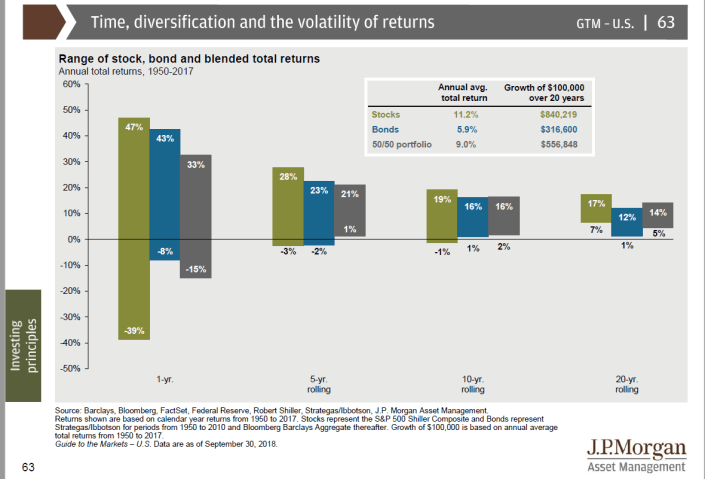
The consistent positive monthly returns of 2016 and 2017 were an exception rather than a rule. Looking historically, you can expect the stock market to jump around when examining time periods of less than five years. A picture is worth a thousand words:

Time, diversification, and volatility


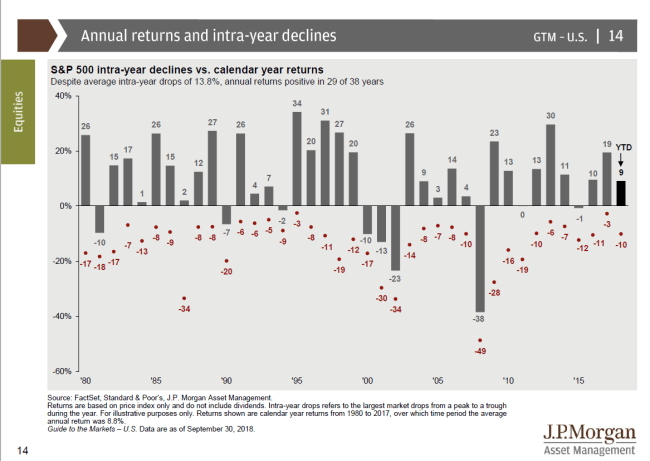
On average, equities return a higher rate because they reward you for going through the ups and downs. Bonds typically return less, because you aren’t subject to such dramatic peaks and valleys.intra year declines

Looking even closer, there are average intra-year drops of -13.8% per year from 1980 to 2017. The average annual return is 8.8%. Even in positive years such as 2016, where the market returned 10%, there was a -11% intra-year decline from a peak to a trough. So what about this year, a year in which news outlets have dramatically claimed HUGE dips in the market? Well, in 2018, we’ve only experienced a -10% market drop and the S&P is positive year-to-date, returning 4% from Jan 1 through today, 11/6. Hardly a tumultuous time in history.

Recognize what news organizations are trying to achieve. Their number one goal is to get you to click on the link to their article. Titling the article “market experiences normal fluctuation, stay the course” isn’t likely to get much traffic. Something along the lines of “Are We All Doomed?” should do the trick. After all, it just worked.

Consistency – What’s It Worth?

You’re a starting pitcher. Before the season, your manager comes to you and says, “Listen, our lineup is going to score 15 runs for you over your next three starts. I guarantee it. However, I need to know how many runs you’d like them to score in each game. I can then coach to make that happen.” What do you tell this prophet coach of yours? You want the team to score five every game? Or maybe 10, 5, and 0? Wait, maybe 4-7-4?  If you want to win all three games, something like 5-5-5 or 5-4-6 is probably your answer. Sure, it would be nice if your team scored 15 and you could bank on a win that night. However, what about the two games they score zero? The point is, sequencing and consistency matters. The same holds true with investing.

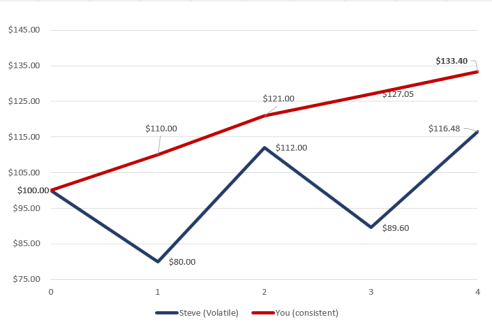
You and your buddy, Steve, head to the casino.  Steve is a wild man, you are a little more strategic. You each start with $100. Each hour, you check in on each other’s progress.

After one hour, he’s down 20% and you’re up 10%. He’s disappointed, but he’s sure that his luck will turn.

Hour two was great for Steve, as he made 40%. You had another uneventful 10% return. Steve is pumped about his awesome performance and gives you a hard time for your weak 10% returns. However, you let him know you’re buying the next round of drinks, as you have $9 more in your pocket. How can this be? Looking at your returns, he was down 20% then up 40%. So +20%, right? You were up 10% and then up 10% again. So also, +20%, right? Well, not exactly. Compounding returns benefited you and hurt Steve. A bad -20% right off the bat proved to be too much to overcome.

You keep playing another two hours…

Start 1 2 3 4 Sum of Returns
Steve -20% 40% -20% 30% 30%
 $ 100.00  $   80.00  $ 112.00  $   89.60  $ 116.48
You 10% 10% 5% 5% 30%
 $ 100.00  $ 110.00  $ 121.00  $ 127.05  $ 133.40

Capture

Just like in the baseball example, a series of consistent, unremarkable returns counts for something in the long run. Despite both netting 30% after four hours, the volatility of Steve’s performance hurts him in the long run. Steve is the baseball team that scores 10 runs one game and 0 the next. He wins one, he loses one. You are the offense that scores five runs in each game and has a chance to win them both. Over a season of 162 games, Steve is probably winning 80 games. He’s definitely losing those where he scores zero, and let’s say he gives up more than 10 runs one time. On the other hand, unless you’re an awful pitcher, you’re definitely winning more than 80 games with your team scoring five runs every single night.

How can you achieve consistent returns with less volatility? Diversification. It’s a buzz word that gets thrown around a lot. The downside of diversification is it’s going to prevent you from hitting it big with an IPO that sees a gain of 300%. The upside is what we just talked about – more consistent, less volatile returns that over time build on themselves and are lucrative. So how do you diversify? Start with looking at ETFs (Exchange Traded Funds) such as SPDR and VOO. These are tied to the S&P 500 as a whole, which are the 500 largest US companies by market share. Want to diversify further? Look at ETFs that represent other groups of companies, such as smaller US companies, large foreign companies, and small foreign companies. Buying an ETF immediately gives you an interest in hundreds of companies, rather than you going out and placing trades for all of them yourself. It’s the quickest, easiest way to becoming that team that consistently scores runs each game and wins in the long run.

What’s It Really Cost?

Should I get McDonald’s for $4 or go to Chipotle for $8? Should I buy a nice leather pair of shoes for $200 or a cheaper pair for $75?  If you’re like me, you ask yourselves things like this all the time. If you’re also like me, you’re probably more inclined for the cheaper option. But lately, after really thinking about it… I always come back to the same line: In the long run, it all evens out. What do I mean by this? Well, a couple McDonald’s burgers probably don’t fill me up for as long as Chipotle would, so my next meal will be sooner, and larger. In addition, the long-term health effects over 10 years of this behavior probably result in some medical bill that wipes out every “savings” I ever experienced on the dollar menu.  Changing examples to the shoe conundrum, the $200 pair probably lasts at least twice as long as the cheaper pair. Maybe even three times as long.  But what is the true cost or price of an item? It’s more than just what they ring you up for at the register. Really, that’s the cost to take the item with you today. It impacts about 1 second. What about the rest of the time you own it?

Factors to consider:

  • How long will it last?
  • Am I going to resell it? (car, home, bicycle, etc.)
  • What are the maintenance and repair costs?
  • What’s the warranty or return policy (one of the reasons I love Costco)
  • How will it impact other areas of my life? Time?

We are constantly confronted with different prices, features, and options when making decisions. Obviously, there are some lavish exceptions to this rule of everything evening out. A $1 million Lamborghini is never going to financially make sense compared to a $40,000 Acura. However, that $50k Audi that doesn’t break down may be a similar purchase to a $20k Chevy. No? Ok, hear me out. Let’s say the Chevy has a modest $10k more in maintenance over 10 years due to lower quality parts. And don’t forget resale value- the Audi probably has another 10k advantage there.  Ok, there’s still a 10k discrepancy: $50k vs. $40k. But what’s the one thing most people overlook? Time. Everyone values their time differently, but there is indeed a price. How much was your time worth as you took the car in for a repair? $50/hour? $100/hour? That can add up quickly. When it’s all said and done, both cars probably cost roughly the same over their life, and one was probably much more fun to drive and own.

This can be a slippery slope, as it’s easy to stop looking at price and find yourself splurging on everything. The very “top of the line” isn’t always necessary, but something (whether a car, lunch, bicycle, house, phone, etc.) that you pay a little more for up-front may actually be cheaper in the long-run. Not to mention, less of a headache. The next time you’re shopping, look past the sticker price and think about the long-term. If you can take good care of a high-quality item, it may just be worth it.

Charge Yourself

If you’re like most people, saving money is easier said than done. You know you should be putting away a few more dollars each month, but things add up and life happens. Maybe you have a budget, maybe you operate more by feel. Either way, it may be a good idea to start charging yourself a set dollar amount each month.

What do I mean by “charging yourself”? Imagine your paycheck hitting your checking account, and before you even have time to see the new funds, $500 has been automatically moved to your savings account (or another account that is considered off-limits). Pay yourself a set amount each month, and keep it in your savings account – somewhere that you vow not to touch. The key to executing this plan is to make the payment automatic. Use technology to your advantage. Set your default behavior to your ideal self. If you’re going to deviate, make yourself go to an effort. It’s too easy to say, “ehhh… I’m just going to do $400 this month, I will make up for it next month.”  If you’re going to skip a month or contribute less than your normal amount, force yourself to go to the effort of opting-out of the transfer.

There are numerous studies showing the impact that defaults have on human behavior. 401(k) plan participation skyrockets for companies that auto-enroll employees and put the onus on them to opt-out should they so choose. You can do the same thing by auto-enrolling yourself in monthly transfers. Another benefit of separating your money into two accounts and keeping one “off-limits,” is you can better track your savings over time as you see the savings account grow.

There are a ton of strategies that people take to help them save more. It’s simple to tell yourself, “don’t spend as much,” but the actual execution is tougher. So set-up an automatic transfer and watch your savings steadily pile up.

How do you handle your paycheck and money? What’s worked an what hasn’t? I’d love to hear from you.

email moneystuff.email@gmail.com

hanalei

photo: Hanalei Bay – Kauai – March 2018

The Game Has Changed

There was once a time where if you worked for 30 years at a solid company you knew your retirement would be comfortable- similar to your current lifestyle in all likelihood. This was all thanks to something called a pension plan.  These plans fall under the category of what’s known as a defined benefit plan. When a portion of your paycheck went to your employer’s retirement account, you were guaranteed a certain benefit per year upon retirement. The employer bore all the investment risk, as employee assets were pooled together and invested.  If the company and stock market did well, the company did well and had plenty of funds to pay employees. If not, the company would still be on the hook to pay employees the same amount.  Today, pension plans are few and far between, with fire and police departments being some of the only organizations offering these defined benefit plans.

Now, defined contribution plans are the norm, and they come in many shapes and sizes. The most common is the 401(k). This plan allows an employee to make a defined contribution from their paycheck (see where they got the name?), and there is often an employer match. However, the investment risk falls on the employee, and how much is available in retirement depends on how well the investments perform.

The switch to defined contribution plans gets companies off the hook for a lot of administration costs and investment risk, which shifts to the employee. However, with greater risk also comes a greater possibility for reward, as a well invested employee with a little luck could have a nice nest egg waiting for them at retirement. Employees can also rollover their 401(k) plans to their own personal IRA if they leave a job, and make their own investment choices.  Defined contribution plans are also conducive to the current trend of employees changing jobs more frequently, as 401(k)s lend the employee a few options when separating from the employer.

In short, employees today have more freedom than ever before, but also more responsibility and risk. No longer can most people just put their head down and work and have their company tell them exactly what their paycheck will be in retirement. Educate yourself, ask questions, and seek help if needed. You must decide what % of pay to contribute to your retirement plan, determine when you are able to retire, and take overall responsibility for your financial well-being. It can be daunting, but there are tons of resources available to help you come up with a plan to take win this new retirement savings game that most of us will be playing.

I’m Back!

You probably didn’t notice, but I haven’t sent anything out or posted an article in a while.  Aside from seeing friends get married, snapping pics of grizzly bears in Wyoming, and watching the M’s, I’ve spent the last month anchored down at my desk studying for the CFP® exam. This six-hour test is the biggest hurdle to becoming a Certified Financial Planner and was a difficult one to study for. Since November, I’ve been working on checking the boxes to become eligible to take the test and then studying for the beast. I will spare you the boring details of the entire process, but long story short, yesterday I passed! This was a huge relief and weight off my shoulders, and now I can get back to getting rid of my Speedo tan lines and writing an article for you every two weeks.

For those wondering, “what the hell is a CFP?”, it is a designation created by the Securities and Exchange Commission (Federal Government) in order to help the public distinguish who they should be able to trust with their finances. Similar to a CPA (Certified Public Accountant), the CFP® designation requires annual continuing education and abiding by certain principles and rules.  Do you remember the commercial a couple years back where a couple is meeting with someone they think is a financial planner, only to learn that he’s a DJ in a shirt and tie? That was put out by the CFP Board as a way to encourage clients to actually look into the credentials of the person advising them. So, before you take someone’s word, ask about their credentials and license. A good place to start would be to see if the letters CFP® are after their name. (I won’t have this for a couple of years, as there is also a requirement to have three years of experience in the industry).  If you are looking for financial help, do your homework and ask questions before starting a relationship with a financial planner. Not every CFP® is going to be a great fit for you, but its a good place to start.

Happy Summer,

David

All That Glitters Isn’t Gold

Saints QB Drew Brees, a future Hall-of-Famer, made headlines this off-season by filing suit against a jeweler in San Diego, claiming he had overpaid by millions of dollars for some pieces of jewelry.  Brees recently had the jewelry appraised for roughly $9 mil. less than what he paid. Maybe I’ve been reading Brees all wrong, but I didn’t have him pegged as a big jewelry guy. At least not someone rocking an $8 million-dollar diamond ring, which was the biggest piece in his collect (turns out its only worth $3.75 mil.).  According to Brees’ camp, he purchased these diamonds in order to “diversify his portfolio.”  Ah, OK, he’s not wearing it, he’s just investing in it.  Wait… WHAT?

I’m throwing a flag here for unsportsmanlike conduct.  There are about 8 million better ways to diversify your investments than to get into the diamond game. Over the past several hundred years, mankind has done a lot of work to create things like money, the stock market, and the internet; all of which make hoarding piles of shiny rocks a thing of the past. Leave the valuable rocks and metals to the people at Fort Knox, Drew.  Buying diamonds as an investment is no different than buying classic cars, paintings, or fancy watches. All do have some resale value, but you better get enjoyment out of the hobby and not rely on it as an investment. There are much easier ways to preserve money and invest your savings.

An athlete with as much money as Brees (or at least he should have, based on career earnings) doesn’t need to take a bunch of risks to be financially wealthy and set generations of future Brees offspring up for the same. If it’s diversification he’s worried about, he could achieve that through a few ETFs (exchange traded funds), a couple mutual funds, and bonds.  Even easier for Brees, he could hire a competent financial planner to take care of this for him. Most high-earning Americans dream of someday accumulating what Brees makes each year in salary and endorsements. He’s in a position of great leverage and could make a ton of money with relatively conservative investments. If Brees doesn’t want to just have stocks and bonds, and wants to invest in things he can see and touch, real estate wouldn’t be a bad move, either. At least with Real Estate, you can go on Zillow and see what millions of people value the home or land at. With the jewelry collection, he’s taking the word of the salesman who’s looking at it under a microscope. The market value of a price is easy to know and find. Depending on where it’s located, it’s pretty stable. In many markets, it will increase over time.  The market value of a diamond…. not so much.

In Football terms, most upper-class Americans Brees’ age (39) are on their own forty yard-line with two minutes left. Tie game. One timeout remaining. They will need to run, pass and take a couple smart, calculated risks if they want to score a touchdown. At the very least, they should be able to play it safe, kick a field goal, and win the game.  By comparison, Drew Brees’ career earnings have put him up by 28 with two minutes left and he’s on the opponents 20 yard line. It’s hard to screw this up. He could kneel, he could run it up the middle, or he could even throw a screen pass just for fun. But investing in jewelry is like calling a flea-flicker and just chucking it up for grabs. It could work, yes. But it’s not needed and best-case will provide the same touchdown that could have been achieved with a few runs and short passes. And that’s the best case!

Brees is far from the first extremely wealthy person to blow a huge chunk of money on some risky investment strategy they were talked into. Unfortunately, athletes (and 50 Cent) are often the ones making headlines for this sort of thing. They’re competitive, want to win big, and are accustomed to taking risks in their careers to achieve their dream. All awesome qualities, just not when it comes to preserving the wealth they’ve worked so hard to gain.  It’s important to remember that for every story about a guy who made millions on Bitcoin, there are two people that squandered the same amount on a risky investment they didn’t know enough about. They just aren’t telling everyone about it.

If you can afford it, there’s nothing wrong with having a diamond collection, fancy cars, rare bottles of wine, pieces of art, or other collectibles. These things can bring people great joy, but shouldn’t be treated as an investment or expected to increase in value. The good news for Brees is that his team is still up by 21 points after throwing this pick-six. It will take a few more flea-flickers before he’s in danger of losing the game. Let’s hope he’s got a coach that can keep that from happening!