Tax season is here… so how can you (legally) owe less to Uncle Sam?
4 Common Ways:
- Tax Deductions and Credits (good)
- Make Less Income (dumb)
- Make Less Taxable Income (smart)
- Get Married (could be any of the above)
Let’s go through each of your options… stay with me here. This will be the quick and painless version of a topic many consider to be dry. But you know what isn’t dry? Keeping more of your hard-earned money.
Deductions and Credits
Tax Deductions reduce your taxable income. For 2019, 99% of us will use what’s called the “Standard Deduction.” Unless you’re donating tens of thousands to charity this year, you’ll be taking the standard deduction of $12,200 in 2019. The Tax Cuts and Jobs act of 2017 doubled the standard deduction, which in effect helped everyone that didn’t have a huge mortgage or were making huge donations. If you’re filing as a married couple, you get a standard deduction for each of you, so $24,400 total.
Tax Credits reduce your tax owed dollar-for-dollar. They’re more impactful than deductions because instead of decreasing your income, they reduce the tax you owe (or increase what the government owes you).
Example: Mookie has taxable income of $100k and has an effective (average) tax rate of 20%. He receives a deduction of $10,000. This saves him $200 in taxes. OR Mookie receives a tax credit of $10,000. This saves him $10,000.
So, how do you get tax credits? Well, there are a quite a few credits the government has come up with, many of them geared towards helping out low-income households and/or college students. The most common credit is the Child Tax Credit ($2k per kiddo).

There are also credits for child-care costs up to $2k. Now, before you tell your spouse you’re ready for some $2k tax credits to be walking around your house, I can assure you that having a child for financial reasons is still not a savvy move. The government is taking pity on you for how much you’re probably spending on diapers, food, and those crazy chairs that move the baby around in some sort of figure eight pattern.
Make Less Income
Really? As they say in “the biz”, don’t let that tax-tail wag the dog. Instead of telling your boss, “Hey, I appreciate the raise but I don’t want to pay more in taxes,” let’s look for other ideas that won’t make you and your spouse hate me.
Make Less Taxable Income
Ok, so what’s the catch? How can you make just as much or more gross income but less taxable income? Save more into your employer’s retirement plan. These are “pre-tax” dollars, meaning they come out of your paycheck before it even gets to you. If you make $500k and had $15k go into your pre-tax 401(k) plan, now your income is only $485k (then subtract standard deduction, etc., to arrive at taxable income). The tax bracket system is progressive, meaning that the more you make, the higher your tax rate is on the next dollar you make. Not only is your total tax bill going to be higher, but the rate increases as you move up the brackets. We must distinguish two VERY important terms you’ll want to know.
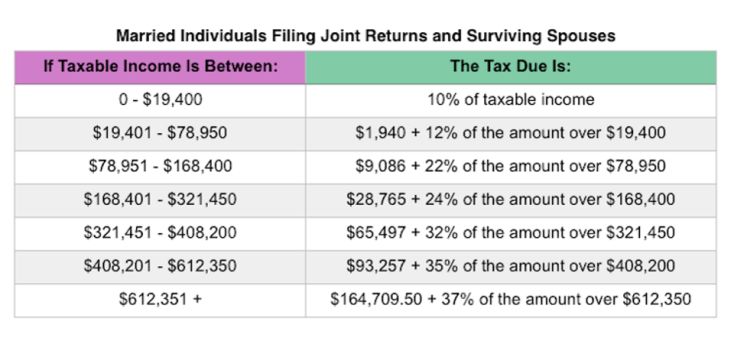
Effective Rate: Tax due divided by taxable income. The average rate you pay.
Steve’s taxable income is $168,400. So, he owes $28,765 in taxes.
($9,086 + (22%*($168,400-$78,950)).
When we divide that by $168,400, that equals an effective rate of 17%. This makes sense, as $19,400 of his income was taxed at 10%, the next $60k was taxed at 12% and the next $90k was taxed at 22%.
Marginal Rate: tax due on the next dollar made.
For Steve, if he made $1 more, what rate would it be taxed at? That’s right, 24%. The marginal rate will always be greater than the effective rate, unless you make less than $19,400. Then, they would be the same.
Still with me? Good. Almost done, I promise.
So what’s the big deal with these brackets? How can they be used strategically? Well, you’ll notice some rather large jumps in the tax brackets. From 12% to 22%, and another big jump from 24% to 32%. Time for our last example:
- Laura makes $90k. She doesn’t contribute any pre-tax dollars to her company 401k. She owes $11,517. Her effective tax rate is 12.8%.
- Cameron makes $90k. She contributes $15k in pre-tax dollars to her 401k plan, lowering her taxable income to $75k. She owes $8,612. Her effective tax rate is 11.4% of $75k. By avoiding the huge marginal spike from 12% to 22%, she saves thousands.
Now, any pre-tax contributions will be taxed at some point. The IRS doesn’t give up that easily. But, the bet is that in retirement you aren’t making much taxable income and your marginal rate is lower than it is today. In addition, you get the compounding growth of that pre-tax $15k over time, which is an immensely powerful thing. By smoothing your income over time, you can avoid dollars being taxed at high marginal rates. There are multiple other ways for people with volatile earnings patterns to be strategic about the amount of their income exposed to high tax brackets during their best years. Professional athletes, entrepreneurs, and entertainers all need to be strategic about ways to defer income. That is, recognize it later in life during years where they are in lower tax brackets. This could especially be huge for a single filer that will be married later in life. This takes us to our final point:
Get Married
There are VERY different tax tables for married couple than for single. But, similar to having kids, don’t let the tax advantage lead you down the aisle. Just know that if you’re filing as “single” you are paying the very highest rates. Deferring income until you’re married could be highly advantageous, especially if your spouse will be making less than you. Try to put as much away pre-tax while you’re filing single. Save money saving money!
That’s it for now. Congrats on getting through this article. Hopefully you feel smarter and are ready to be tax efficient. Let me know if you have any questions.
-David
PS. TurboTax suits the vast majority of people just fine, especially when younger and without a ton of complexity. Many enlist the help of a CPA, but unless you have a complicated/unique tax situation, it may not be worth the cost, which can be hundreds to thousands. Examples of when a CPA may be especially helpful are if you have multiple income streams, large amounts of investment income/losses on your form 1099s, investment properties, child support, owning a business, etc.
 MoneyStuff