You’re a starting pitcher. Before the season, your manager comes to you and says, “Listen, our lineup is going to score 15 runs for you over your next three starts. I guarantee it. However, I need to know how many runs you’d like them to score in each game. I can then coach to make that happen.” What do you tell this prophet coach of yours? You want the team to score five every game? Or maybe 10, 5, and 0? Wait, maybe 4-7-4? If you want to win all three games, something like 5-5-5 or 5-4-6 is probably your answer. Sure, it would be nice if your team scored 15 and you could bank on a win that night. However, what about the two games they score zero? The point is, sequencing and consistency matters. The same holds true with investing.
You and your buddy, Steve, head to the casino. Steve is a wild man, you are a little more strategic. You each start with $100. Each hour, you check in on each other’s progress.
After one hour, he’s down 20% and you’re up 10%. He’s disappointed, but he’s sure that his luck will turn.
Hour two was great for Steve, as he made 40%. You had another uneventful 10% return. Steve is pumped about his awesome performance and gives you a hard time for your weak 10% returns. However, you let him know you’re buying the next round of drinks, as you have $9 more in your pocket. How can this be? Looking at your returns, he was down 20% then up 40%. So +20%, right? You were up 10% and then up 10% again. So also, +20%, right? Well, not exactly. Compounding returns benefited you and hurt Steve. A bad -20% right off the bat proved to be too much to overcome.
You keep playing another two hours…
| Start | 1 | 2 | 3 | 4 | Sum of Returns | |
| Steve | -20% | 40% | -20% | 30% | 30% | |
| $ 100.00 | $ 80.00 | $ 112.00 | $ 89.60 | $ 116.48 | ||
| You | 10% | 10% | 5% | 5% | 30% | |
| $ 100.00 | $ 110.00 | $ 121.00 | $ 127.05 | $ 133.40 |
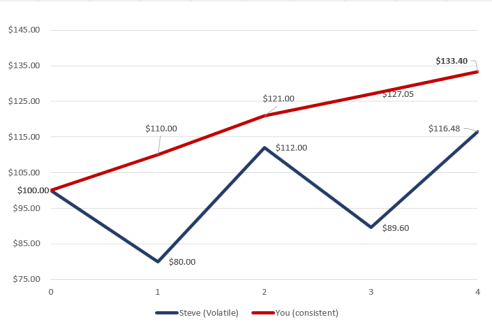
Just like in the baseball example, a series of consistent, unremarkable returns counts for something in the long run. Despite both netting 30% after four hours, the volatility of Steve’s performance hurts him in the long run. Steve is the baseball team that scores 10 runs one game and 0 the next. He wins one, he loses one. You are the offense that scores five runs in each game and has a chance to win them both. Over a season of 162 games, Steve is probably winning 80 games. He’s definitely losing those where he scores zero, and let’s say he gives up more than 10 runs one time. On the other hand, unless you’re an awful pitcher, you’re definitely winning more than 80 games with your team scoring five runs every single night.
How can you achieve consistent returns with less volatility? Diversification. It’s a buzz word that gets thrown around a lot. The downside of diversification is it’s going to prevent you from hitting it big with an IPO that sees a gain of 300%. The upside is what we just talked about – more consistent, less volatile returns that over time build on themselves and are lucrative. So how do you diversify? Start with looking at ETFs (Exchange Traded Funds) such as SPDR and VOO. These are tied to the S&P 500 as a whole, which are the 500 largest US companies by market share. Want to diversify further? Look at ETFs that represent other groups of companies, such as smaller US companies, large foreign companies, and small foreign companies. Buying an ETF immediately gives you an interest in hundreds of companies, rather than you going out and placing trades for all of them yourself. It’s the quickest, easiest way to becoming that team that consistently scores runs each game and wins in the long run.
 MoneyStuff