Arguably more important than getting buckets at your local YMCA, getting financial buckets in an excel  spreadsheet can bring you serious peace of mind. “How much should I invest? What should I keep in savings? When should I invest in the stock market?” Often, the most common questions are the most important questions. Here are some basic, fundamental bucketing rules that will set you up for success:
Bucket 1: Cash *Priority #1
- A good rule of thumb is to keep 3-6 months of basic living expenses (rent/mortgage, food, transportation, etc.) in “cash.”
- “Cash” doesn’t mean wads of twenties in your sock drawer, but rather just money in a place that you can access at any time without penalty. So whether that’s in a checking account, a high-yield savings account (available at most major banks), or actual cash, having this buffer will set yourself up for success.
- The unexpected can happen- good or bad- and now you will be prepared for it. Having cash on hand will bring you peace of mind. Lose your job? You have months to find a new one. Need to pay the premium due to a fender bender? Use these funds rather than pulling from your investments in your other buckets or taking out a loan. Want to buy those Final Four tickets? You won’t need to dip into your investments. You get the point.
- If you are forced to use this cash, your goal should be to replenish it back to its original balance.
- Sitting down and calculating what you could really be living on each month can be a great exercise and help you become more conscious of your spending habits. Be warned though, you may see your next monthly credit card bill and wonder, “how the hell did that happen?”
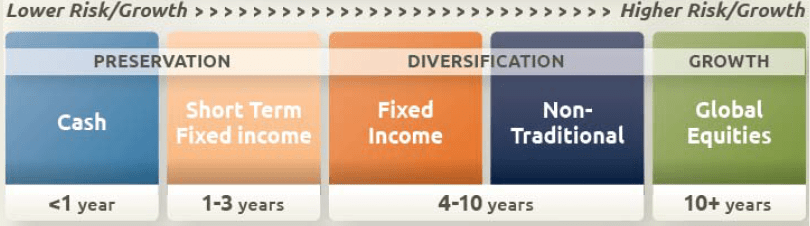
Buckets 2-4: Investments
- We will go into these specifically in the future. Just remember that the sooner the need the money, the more conservative you should be. If you know you won’t touch the funds it for 10 years (retirement), you can be really aggressive right now. Why 10-years? In the history of the stock market, the market as a whole has provided positive returns in 95% of all 10-year time periods. Yes, even when the Great Recession of 2008 is included. If you can guarantee that you won’t touch this bucket of money for the next decade, it’s a pretty sure bet you will have at least as much money as when you started. And that’s a good feeling. Instead of buying individual stocks, you are likely better off by getting ETFs (exchange traded funds) such as SPDR or VOO. If stocks are individual players, index funds are like teams. SPDR and VOO are teams comprised of the 500 biggest public companies (Apple, Google, Amazon). If the stock market is doing well, these teams are doing well. Even if a couple individual players are having a bad season, the team still succeeds. The trick is, not pulling your money out when the team goes on a losing streak. None of us have time to research and trade individual stocks and try to consistently beat the market.
- Since 1928, the stock market has an average annual return of 10%. In 2017, that return was 19%. In other years, it may be negative. If you are going to invest in SPDR or VOO, you need to be able to withstand these peaks and valleys in order to experience growth.
3 Key Takeaways
#1: Have a bucket of funds you can access immediately, should anything come up.
#2: Invest with goals and a timeline in mind.
Short Term, play it safe.
Long term, can afford more fluctuation in value.
#3: Individual stocks are overrated and won’t win consistently. For every one stock that does well for you, another will tank. Professional stock traders have a goal of beating the index (S&P 500) by maybe 1 or 2%. As an individual investor, just get an index fund and let it ride. (SPDR or VOO are great to start with).
 MoneyStuff